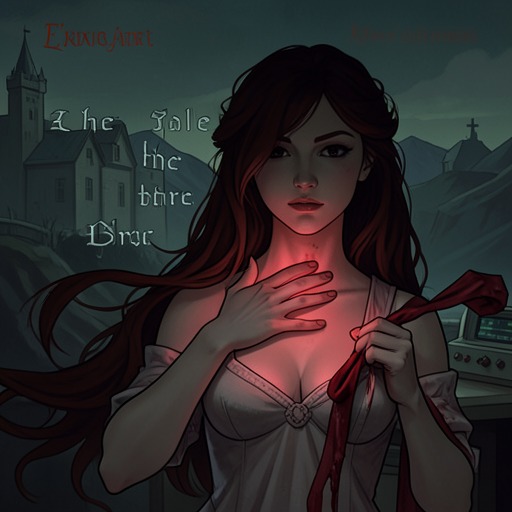
The Dracul Ring
The Tale of the Vampire BrideThe Dracul Ring is Vlad Dracula’s ring and seal, most significantly associated with Glynis Wright’s captivity, marriage, and contested identity. Its importance is not limited to ornament: the ring makes Vlad’s claim over Glynis legible to others, especially through the red-dragon mark associated with the Dracula household, while Glynis’s response to it exposes the difference between imposed possession and chosen allegiance.
Appearance and Heraldic Function
The ring is identified with the Dracul seal, a mark displayed on the gate of Vlad Dracula’s residence in Buda: a “V” with a red dragon curled around it. Ignatius recognizes the sign and names its owner, connecting the household’s architecture with the object on Glynis’s hand. When Glynis looks down at the ring and Ignatius follows her gaze, the two forms of the emblem—the public mark on the gate and the private mark worn on her body—become equivalent signs of Vlad’s authority.
The ring therefore operates as a heraldic device and a claim of possession. Ignatius explains that Vlad places his seal on everything he possesses. In that context, the ring does not simply identify Glynis as a member of an aristocratic household; it presents her as property within Vlad’s domain. Its meaning is produced through contrast with the other visible signs of her status: English clothing, the title of Lady Glynis, the title of Countess Dracula, and the veil Vlad orders her to wear around Andrew Wright.
The Ring Within Glynis’s Captivity
Glynis’s relationship to the ring develops alongside her struggle to control how her transformed body is seen. Before becoming a vampire, she imagines a woman’s freedom through the rejection of restrictive social expectations, wishing to live as a woman who could act without the constraints imposed on her sex. After her transformation, however, the castle imposes another system of clothing, obedience, and display. She resents being forced out of her own clothes and into an outfit she considers degrading, just as she later resists the veil that hides her face from Andrew.
The ring belongs to this same politics of visible identity. Vlad orders Glynis to discard clothing, jewelry, and other possessions her brother might recognize when they travel to Buda. He intends to conceal the truth of her survival and prevent Andrew from identifying her through familiar objects. At the same time, the ring remains a sign of Vlad’s claim, even when other markers of Glynis’s former life are removed. The contrast is deliberate: her Paris dresses are used to construct a new appearance, while Vlad’s seal preserves the authority behind that appearance.
The object consequently participates in the contradiction at the heart of Glynis’s existence as Vlad’s bride. She can appear as an elegant countess, and Vlad provides her with a fine black-and-gold dress for the opera, but the ring makes that splendor inseparable from ownership. Clothing can stage aristocratic dignity; the Dracul Ring reveals the coercive power beneath the stage.
Possession and Counter-Claim
The ring’s strongest emotional charge appears during Glynis’s meeting with Ignatius. After he recognizes the Dracul mark and explains its meaning, Glynis looks at the ring rather than denying its significance. She then states that her heart belongs to Ignatius. This declaration does not erase Vlad’s seal or free her from the blood-bound structure governing her life, but it creates a competing meaning for the object’s presence.
The scene distinguishes bodily possession from inward attachment. Vlad’s mark can be placed upon what he owns, and Glynis’s ring visibly identifies her within his estate; yet Glynis insists that her heart cannot be reduced to the seal on her hand. Ignatius receives that declaration as a source of salvation in darkness, making the ring the occasion for a private counter-pledge rather than a simple confirmation of Vlad’s power.
The counter-claim is precarious because Glynis remains caught between loyalty, coercion, and desire. Vlad tells her that she must answer his beckoning and presents her future as his true bride, while Ignatius’s love threatens both his religious penance and his submission to the existing order. The ring thus stands at the intersection of two bonds: Vlad’s possessive authority and Glynis’s attempt to name a relationship that she experiences as her own choice.
Symbolic and Narrative Significance
As a recurring sign, the Dracul Ring condenses the novel’s conflict between social identity and self-determination. Glynis has already challenged the gendered restrictions of her former life, only to enter a supernatural hierarchy in which the title of bride, the rules of the castle, the veil, and the master’s seal regulate her appearance. The ring makes that reversal concrete. It is small enough to wear privately, yet its meaning expands whenever another character recognizes it.
The ring also belongs to the story’s broader contrast between human and vampiric forms of binding. Religious objects such as Antoinetta Wright’s rosary and crucifix represent prayer, family memory, and the hope of mercy; blood and the Dracul seal represent the rival authority of vampiric possession. Antoinetta buries her rosary before giving Glynis blood and asking her to live and escape, while the ring remains attached to Glynis as evidence of the power from which she seeks freedom. These objects do not carry identical meanings, but their juxtaposition makes Glynis’s transformation a struggle between competing systems of inheritance, obligation, and salvation.
The ring’s final importance lies in its ambiguity. It is both a sign that Glynis has been claimed and a surface upon which she can articulate resistance. Vlad’s seal identifies her within his world, but it cannot fully determine what she loves, remembers, or promises. In that tension, the Dracul Ring becomes an emblem of the novel’s central question: whether a body marked by another’s power can still sustain an allegiance that belongs to the self.